

Over the last several years, I’ve seen a significant increase in adults who come to me wondering whether they have ADHD. Some have been struggling their entire lives and are only now putting a name to it. Others read something online, saw themselves in a TikTok video, and started to wonder. Both are valid starting points — but they both deserve the same thing: an honest, thorough evaluation.
Here’s what a real ADHD assessment looks like, why shortcuts can cause more harm than good, and what you should expect from the process.
Why Getting the Diagnosis Right Matters
ADHD is frequently misdiagnosed — in both directions. Some people receive the diagnosis when what they actually have is anxiety, depression, a learning disability, or simply the effects of chronic stress and burnout. Others who genuinely have ADHD go unrecognized for years because their presentation doesn’t fit the stereotypical image.
Both mistakes have consequences. An incorrect ADHD diagnosis can lead to unnecessary medication and miss the real problem. A missed ADHD diagnosis means years more of struggling, self-blame, and wondering what’s wrong with you.
What a Thorough ADHD Assessment Actually Involves
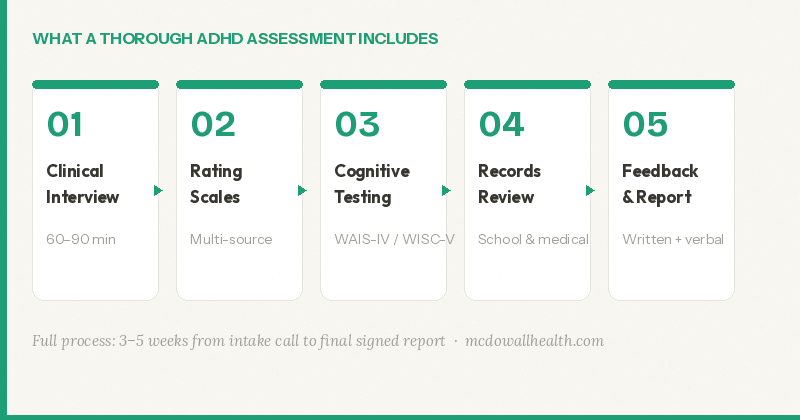
A good evaluation is not a 20-minute appointment. It is not a questionnaire you fill out online. And it should never rely on self-report alone. In my experience, the most accurate ADHD assessments include all of the following:
A comprehensive clinical interview
This is where the assessment begins — and it should take time. Your psychologist will want to know about your developmental history, how you performed in school, your current challenges at work and in relationships, and whether these problems have been present since childhood. ADHD doesn’t start in adulthood — it begins before age 12, even if it wasn’t recognized until much later.
Standardized rating scales
You’ll complete validated questionnaires that measure attention, impulsivity, hyperactivity, and related symptoms. For children, parents and teachers are asked to complete their own ratings. This cross-informant approach matters enormously — it’s the difference between “I struggle to focus” and documented evidence of how that struggle shows up across settings.
Cognitive and performance-based testing
Tests like the WAIS-IV or WISC-V measure working memory, processing speed, and executive functioning — areas frequently affected by ADHD. They also help rule out learning disabilities, which can look a lot like ADHD from the outside.
A feedback session with a written report
After all the testing, you should receive a clear explanation of what was found — verbally and in writing. The report should be thorough enough to be used with schools, employers, your prescribing doctor, or an insurance company. If the assessor can’t give you that, find someone who can.
5 Questions to Ask Before Booking an ADHD Assessment
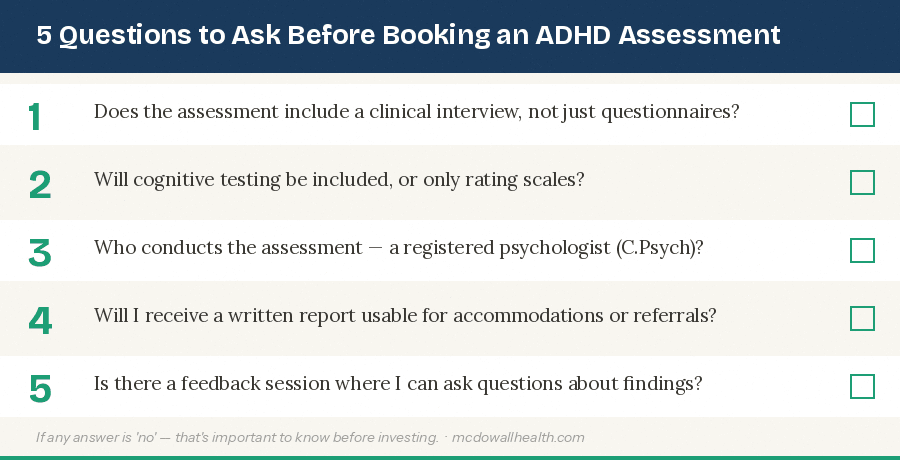
- Does the assessment include a clinical interview, not just questionnaires?
- Will cognitive testing be included, or only rating scales?
- Who will conduct the assessment — a registered psychologist or a supervised trainee?
- Will I receive a written report I can use for accommodations or medical referrals?
- Is there a feedback session where I can ask questions about the findings?
If the answer to any of these is no or unclear, that’s worth knowing before you invest your time and money.
What If the Assessment Doesn’t Find ADHD?
This happens — and it’s not a failure. In fact, some of the most valuable assessments I conduct are the ones that identify something other than what the person came in expecting. A thorough evaluation doesn’t just rule in ADHD — it also identifies anxiety, depression, trauma responses, or learning disabilities that may be driving the same struggles. That clarity is its own form of progress.
After the Diagnosis: What Comes Next
A diagnosis is not an endpoint. It’s a starting point. Whether or not ADHD is confirmed, a good assessment ends with a roadmap — specific recommendations for therapy for ADHD, medication consultation, academic accommodations, workplace supports, or coaching.
At McDowall Health, we see clients in Toronto, Mississauga, and Brampton, and virtually across Ontario. Our assessments are designed to give you real answers, not just a label.
Ready to take the next step? McDowall Integrative Psychology & Healthcare offers assessments in Toronto, Mississauga, and Brampton — and virtually across Ontario. Call (416) 485-5555 or book online to get started.
Related reading: Why so many women are only now finding out they have ADHD | Is it ADHD or anxiety? How to tell the difference | How long does an ADHD assessment actually take? | ADHD assessment or psychoeducational assessment — which does your child need?
Frequently Asked Questions
Can a psychologist diagnose ADHD without a referral in Ontario?
Yes. You can book a private ADHD assessment at McDowall Health without a referral from a doctor. Our registered psychologists are qualified to diagnose ADHD in children and adults.
Is an ADHD assessment covered by OHIP?
Private psychological assessments are not covered by OHIP. Many extended health benefit plans cover a portion of the cost — check with your insurer. Visit our fees page for current McDowall Health pricing.
How is adult ADHD assessment different from a child’s assessment?
Adult assessments place more emphasis on self-report, work functioning, and retrospective developmental history. Since ADHD must have been present before age 12, your psychologist will explore your childhood carefully — sometimes through interviews with family members. The tools used are also age-normed differently.
What if I’ve been managing fine until recently — can I still have ADHD?
Absolutely. Many adults with ADHD managed reasonably well through school by working harder than everyone else, relying on structure, or having support systems in place. When those scaffolds disappear — a new job, parenting, university — the ADHD becomes impossible to compensate for. This is one of the most common presentations I see in adults.