
Parents often ask me about gifted assessments with a mix of excitement and uncertainty. They’ve noticed something about their child — an unusual depth of thinking, questions that catch them off guard, a hunger for knowledge that the classroom doesn’t quite satisfy. But they’re not sure whether what they’re seeing is genuinely exceptional, or whether they’re simply proud parents.
Here’s what I tell them: the only way to know is through formal gifted assessment Ontario testing conducted by a registered psychologist. And if the results confirm giftedness, that assessment opens doors — to programs, to accommodations, to an educational path — that intuition alone never could.
What Does “Gifted” Actually Mean in Ontario?
Giftedness isn’t just being a fast learner or a well-behaved student who gets good grades. In Ontario, giftedness is formally defined as an unusually advanced degree of general intellectual ability that requires differentiated learning experiences beyond those normally provided in the regular school program.
Most Ontario school boards use a Full Scale IQ of 130 or above on a standardized test like the WISC-V as the threshold for gifted identification. This places the child in approximately the top 2% of the population for their age group. A standalone IQ score, however, is only the beginning of what a good assessment tells you.
What the IQ Test Measures — and What It Doesn’t
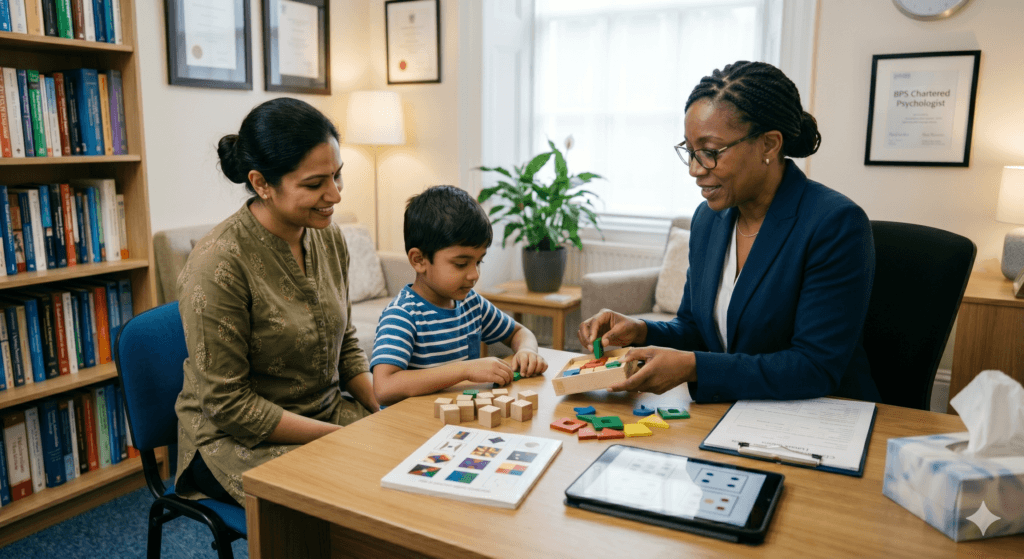
The WISC-V (Wechsler Intelligence Scale for Children, Fifth Edition) is the most widely used cognitive assessment for school-aged children in Ontario and across Canada. It measures intellectual ability across five index areas: verbal comprehension, visual-spatial thinking, fluid reasoning, working memory, and processing speed. The result is both a Full Scale IQ and a detailed profile of strengths and relative weaknesses.
What it doesn’t measure: creativity, motivation, emotional intelligence, or potential for life success. These things matter enormously — but they’re not what IQ tests are designed to capture. The test is a clinical tool for understanding cognitive functioning, not a verdict on your child’s worth or their future.
For a full explanation of what different IQ scores mean in the Ontario context: What IQ Score Is Actually Gifted? The Numbers Explained
Why the Profile Matters as Much as the Number
One of the most important things I communicate to parents after a gifted assessment is this: the Full Scale IQ is only part of the story. A child can score at or above the gifted threshold overall while showing significant variability across the five index areas — excellent fluid reasoning alongside weaker working memory, for instance, or outstanding verbal ability alongside slower processing speed.
This variability is especially common in twice-exceptional children — those who are intellectually gifted and also have ADHD, a learning disability, or anxiety. In these children, strengths and challenges can mask each other so effectively that neither is recognized without comprehensive testing. A thorough gifted assessment is the only way to see the full picture and make recommendations that serve both sides of it.
For more on this profile: When Your Child Is Both Gifted and Struggling: Understanding Twice-Exceptional Kids
How the Assessment Connects to Ontario School Programs
If your child qualifies as gifted, the assessment report from a registered psychologist can be submitted to your school board’s Identification, Placement, and Review Committee (IPRC) — the formal process through which children are identified as exceptional and placed in gifted programs. This is a critical step: without a formal IPRC identification, access to gifted programming is not guaranteed, regardless of how capable your child clearly is.
A private gifted assessment often significantly accelerates this timeline. Rather than waiting for the school board to complete its own evaluation — which can take many months — you can bring the private psychologist’s report directly to the IPRC process. School boards in Toronto, Mississauga, Brampton, and across Ontario accept assessments from registered psychologists in private practice.
If your child may need both gifted assessment and evaluation for a learning difference, see: IQ Test vs. Psychoeducational Assessment: Which Does Your Child Need?
What Happens If the Score Comes Back Lower Than Expected
Sometimes children score in the high-average or superior range — IQ 120 to 129 — rather than at or above the gifted threshold of 130. This is still excellent cognitive performance. It just doesn’t qualify under most Ontario school board definitions of giftedness.
In these cases, the assessment still has genuine value. It confirms your child’s intellectual strengths, provides a cognitive profile that guides educational planning, and helps you advocate for enrichment, advanced coursework, or extracurricular challenge at an appropriate level. The knowledge gained from the assessment doesn’t disappear because a program threshold wasn’t met.
When Is the Right Time for Testing?
For IQ testing gifted program Ontario purposes, I generally recommend waiting until a child is at least six years old — results are more reliable and more stable at this age than in younger children. Avoid testing during periods of significant stress: illness, a family disruption, or a major transition. The goal is an accurate picture of your child’s typical cognitive functioning, not a snapshot of their most difficult day.
For practical guidance before assessment day: How to Prepare Your Child for an IQ or Gifted Assessment
Ready to take the next step? McDowall Integrative Psychology & Healthcare offers gifted assessment for children in Ontario in Toronto, Mississauga, and Brampton — and virtually across Ontario. Call (416) 485-5555 or book online to get started.
Related reading:
- What IQ Score Is Actually Gifted? The Numbers Explained
- When Your Child Is Both Gifted and Struggling: Understanding Twice-Exceptional Kids
- How to Prepare Your Child for an IQ or Gifted Assessment
- IQ Test vs. Psychoeducational Assessment — Which Does Your Child Need?
Frequently Asked Questions
How much does a gifted assessment cost in Ontario?
Private gifted assessment ontario cost ranges typically from $1,500 to $2,500. Contact McDowall Health at (416) 485-5555 or visit our fees page for current pricing information.
Is a private gifted assessment accepted by Ontario school boards?
Yes. Psychological assessment reports from registered psychologists are accepted by Ontario school boards as part of the IPRC gifted identification process. The report must be prepared by a registered psychologist (C.Psych) in Ontario. McDowall Health’s assessments meet this standard.
Can a gifted assessment also identify learning disabilities?
A standalone gifted assessment (cognitive testing only) is not designed to identify learning disabilities. If you want to evaluate both giftedness and potential learning challenges — for example, if your child is suspected to be twice-exceptional — a combined psychoeducational assessment is the better option. Our team will discuss the right scope with you during intake.
How long does a gifted assessment take?
A gifted IQ assessment typically involves one session of two to three hours of direct testing with your child, preceded by a parent intake and followed by a feedback session and written report. From initial contact to receiving the report, you can generally expect a timeline of three to five weeks at McDowall Health.