

Parents often describe the same experience to me: their child is bright — curious, creative, great at conversation — but school is a constant battle. Homework takes three times longer than it should. Teachers say they’re not trying hard enough. The child is frustrated, starting to say they’re “stupid,” and dreading going to class.
If this sounds familiar, a psychoeducational assessment may be exactly what your family needs.
What Is a Psychoeducational Assessment, and Why Does It Matter?
A psychoeducational assessment is a comprehensive evaluation conducted by a registered psychologist that measures how your child thinks, learns, and processes information. It looks at cognitive ability (IQ), academic achievement in reading, writing, and math, and the underlying processing skills that support — or interfere with — learning.
The goal isn’t just to identify what’s wrong. It’s to build a complete picture of your child’s strengths and challenges so that the right supports can be put in place.
What the Assessment Actually Tells You
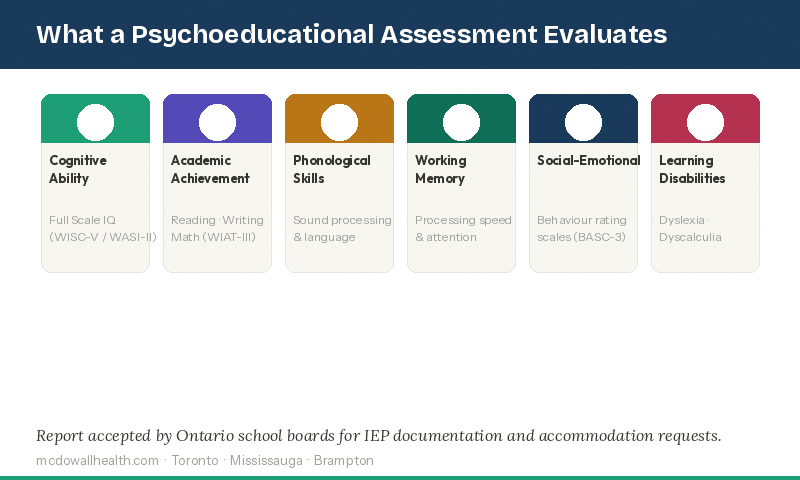
Here’s why psychoeducational assessments are so valuable: they answer questions that no amount of teacher feedback or school report cards can. Specifically:
- Is there a learning disability such as dyslexia, dyscalculia, or a language processing disorder?
- Is your child’s cognitive ability significantly higher than their academic output — and if so, why?
- Are attention or executive functioning difficulties driving the academic struggle?
- Is anxiety playing a role in how your child performs on tests?
- What specific accommodations should the school be providing?
Many of the children I assess have been quietly struggling for years — working twice as hard as their classmates just to keep up, hiding their difficulties, and internalizing the message that they’re just not smart enough. The assessment often reframes that narrative entirely.
Signs Your Child May Benefit From an Assessment
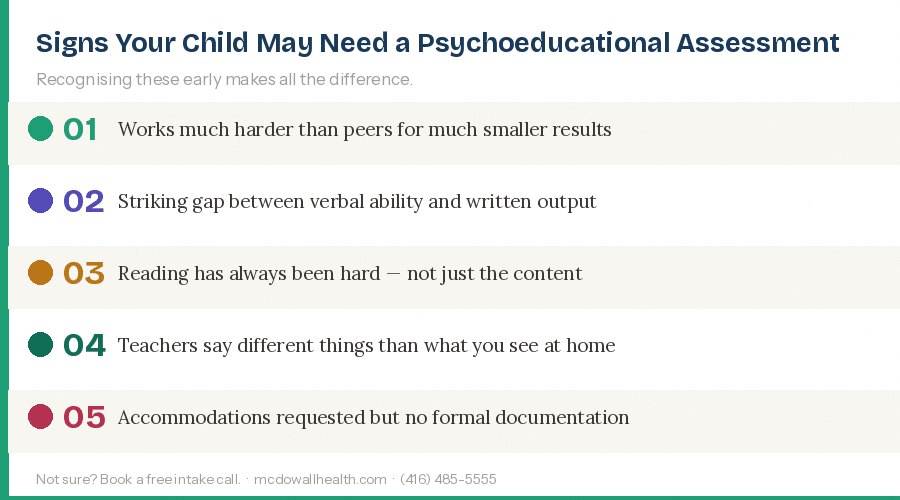
Consider booking an assessment if your child:
- Reads slowly, avoids reading aloud, or struggles with spelling despite practice
- Has strong verbal ability but messy, avoidant, or disorganized written work
- Takes significantly longer than peers to complete assignments, even with effort
- Performs inconsistently — excelling in some areas, falling far behind in others
- Gets anxious, tearful, or frustrated with schoolwork in a way that feels disproportionate
- Has been described as “not reaching their potential” by multiple teachers
- Needs documentation for an IEP or school accommodation request
You don’t need to have a clear answer about what’s going on before booking. That’s exactly what the assessment is for.
What the Process Looks Like
Testing typically spans two sessions of three to four hours each. Your psychologist begins with a detailed parent interview to gather developmental history, then conducts a range of cognitive and academic tests directly with your child. Rating scales are sent to teachers and completed by parents as well.
Afterward, your psychologist writes a comprehensive report and schedules a feedback session to walk you through the findings and recommendations. This is not a quick process — but it’s thorough for a reason. The report your child receives needs to stand up with their school, their university, and potentially their employer for years to come.
The Public vs. Private Assessment Question
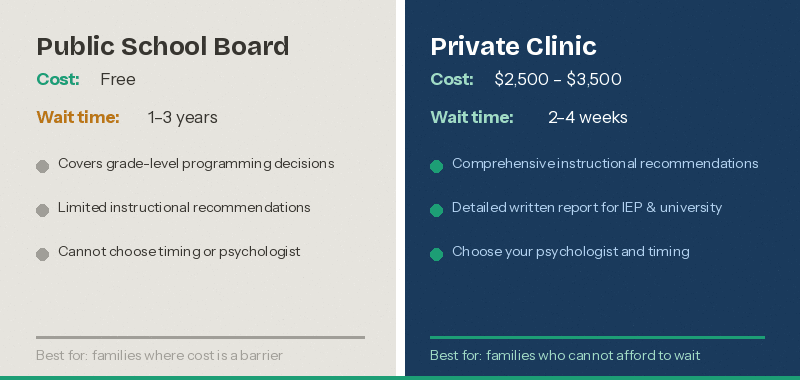
Ontario school boards are required to conduct psychoeducational assessments for students with suspected learning disabilities — and they’re free. The catch? Wait times of one to three years are common. During that time, your child continues to struggle without formal support or documentation.
Private assessments at a clinic like McDowall Health are typically available within weeks, not years. The cost is significant, but the impact of intervening early — before your child’s self-esteem erodes further — often outweighs it.
For full cost information, see:
How much does a psychoeducational assessment cost in Ontario?
What Happens After the Assessment
A good psychoeducational report doesn’t just describe problems — it provides a roadmap. Specific recommendations for classroom accommodations, instructional strategies, therapy referrals, and further evaluations are all part of what you receive. Your psychologist will also help you understand how to bring these recommendations to your child’s school.
Many families tell me that getting this report was a turning point — not just for their child’s education, but for their child’s relationship with themselves.
Ready to take the next step? McDowall Integrative Psychology & Healthcare offers assessments in Mississauga, Toronto, and Brampton — and virtually across Ontario. Call (416) 485-5555 or book online to get started.
Related reading: 5 signs your child may need a psychoeducational assessment | What to do if you think your child has dyslexia | IQ test vs psychoeducational assessment — which does your child need? | ADHD assessment or psychoeducational assessment?
Frequently Asked Questions
Can a psychoeducational assessment diagnose ADHD?
Often, yes. Many psychoeducational assessments include an ADHD evaluation component, especially when attention and executive functioning concerns are part of the referral question. Your psychologist will discuss this with you before the assessment begins.
My child’s school says they’re ‘fine’ — should I still get an assessment?
Schools assess based on grade-level expectations, and a child who is bright can appear ‘fine’ while actually working far harder than necessary just to keep pace. If you’re noticing signs at home that concern you — avoidance, frustration, emotional reactions to schoolwork — those are worth taking seriously regardless of what the school report says.
Does my child need a referral to book a private assessment?
No. You can contact McDowall Psychology directly to schedule a psychoeducational assessment for your child. No physician referral is required for a private psychological assessment.
How recent does the assessment need to be for school accommodations?
For primary and secondary school, most Ontario school boards will accept a recent report. For post-secondary accommodations, universities and colleges typically require a report conducted within the past three to five years. If your child’s report is older than that and they’re heading to university, it may be time to update it.